30 Oct 2026
Mapping Development Phases in Digital Networking Ecosystems Through Historical Milestones and Community Dynamics
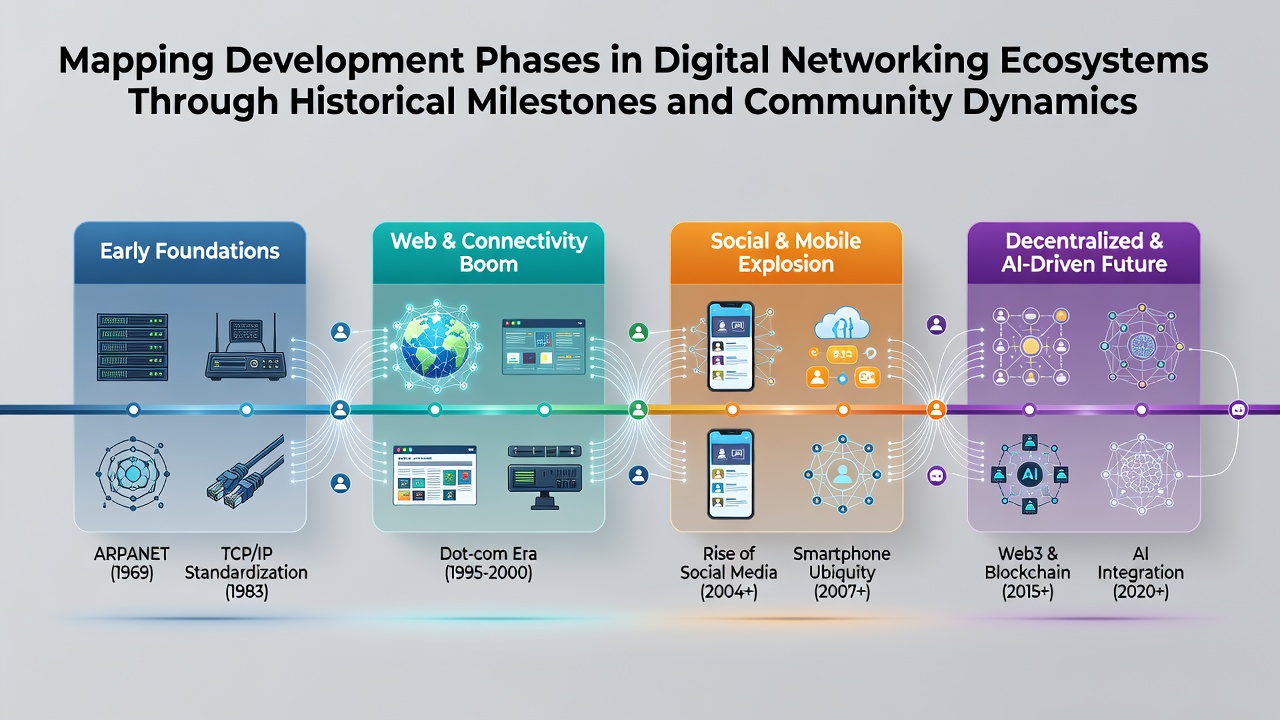
Digital networking ecosystems have evolved through distinct phases shaped by technological breakthroughs and the collective actions of user communities since the late 1960s. Researchers trace these shifts from experimental packet-switched networks to interconnected platforms where participation patterns influence growth trajectories and structural changes occur over decades.
Early Foundations in the 1960s and 1970s
ARPANET launched in 1969 as a project funded by the US Department of Defense Advanced Research Projects Agency and it established the first wide-area packet switching network that connected university computers across multiple sites. Data transmission tests conducted in that period demonstrated reliable message routing while community input from academic researchers refined protocols such as TCP/IP which became standardized in 1983. Observers note that these initial groups formed around shared technical documentation and mailing lists where contributors exchanged code snippets and troubleshooting methods that accelerated adoption among defense contractors and educational institutions.
Expansion During the 1980s and 1990s
Commercial internet service providers entered the market after the National Science Foundation lifted restrictions on backbone usage in 1991 and this transition enabled broader access that moved networking beyond government and academic circles. The World Wide Web introduced by Tim Berners-Lee at CERN in 1989 gained momentum through browser developments like Mosaic in 1993 which allowed graphical navigation and spurred content creation by individuals and small organizations. Community dynamics during this era centered on newsgroups and early forums where users debated standards and organized collaborative projects such as the development of Linux kernel contributions that began in 1991 and drew thousands of programmers worldwide by the end of the decade.
Web 2.0 and Social Platform Emergence in the 2000s
Platforms like Friendster launched in 2002 followed by LinkedIn and MySpace in 2003 and Facebook in 2004 shifted focus toward user-generated profiles and interactive features that encouraged repeated engagement. Data from the Pew Research Center indicates that social media usage among American adults rose from 5 percent in 2005 to 69 percent by 2016 with similar patterns observed in European and Asian markets according to reports from the Organisation for Economic Co-operation and Development. Community moderation practices emerged organically on sites like Reddit which started in 2005 and Wikipedia which began in 2001 where volunteer editors established governance rules that sustained large-scale content production without central oversight.
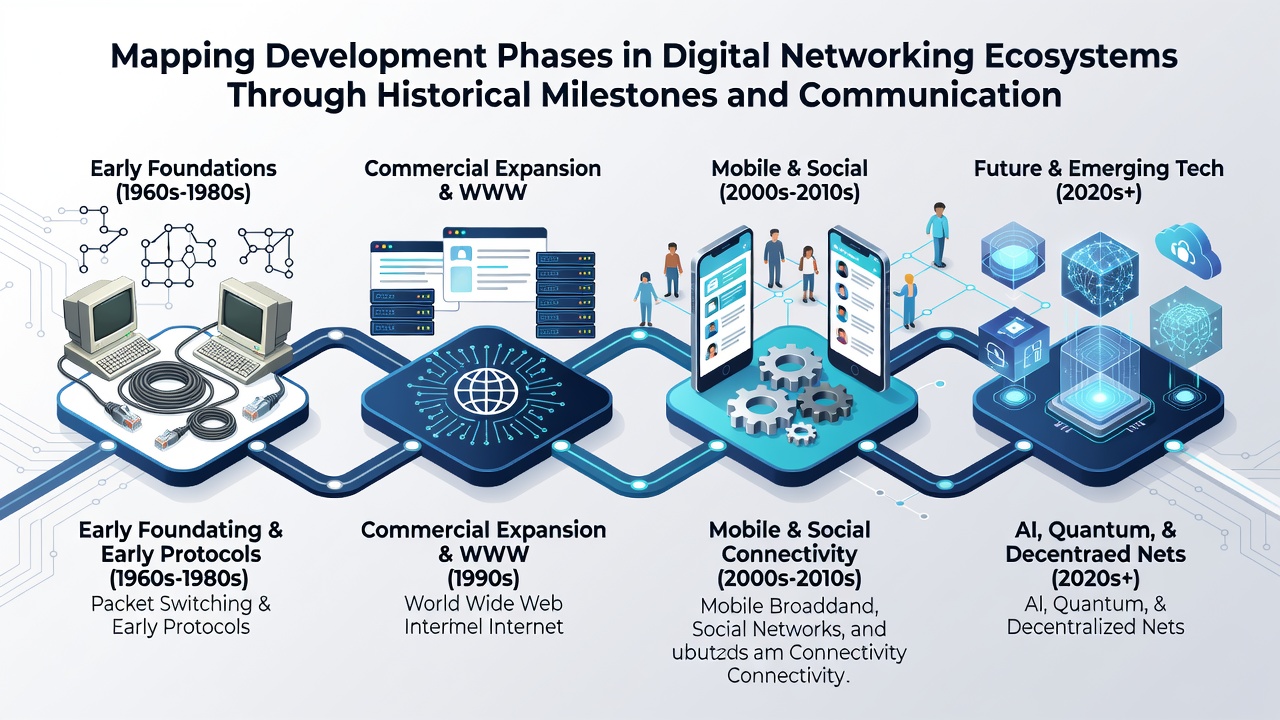
Smartphone proliferation after the iPhone release in 2007 and Android expansion shortly afterward integrated networking into daily routines through mobile applications that supported real-time updates and location-based interactions. Studies from the International Telecommunication Union show global internet users grew from 1 billion in 2005 to over 4.5 billion by 2020 with mobile devices accounting for more than half of connections in many regions. Those tracking these trends point to open-source communities and hackathons as key drivers that introduced features like API integrations which allowed third-party developers to extend platform capabilities.
Decentralized and Current Ecosystem Shifts
Interest in decentralized protocols gained traction after blockchain networks such as Ethereum launched in 2015 and enabled peer-to-peer applications that reduced reliance on single operators. In October 2026 the Global Digital Infrastructure Forum scheduled in Singapore will convene representatives from regulatory bodies across the European Union, Australia, and Canada to discuss interoperability standards for emerging networks. Academic analyses from institutions like the Massachusetts Institute of Technology highlight how distributed ledger communities coordinate upgrades through governance tokens and proposal systems that mirror earlier open-source decision processes.
Figures from the Internet Society reveal that IPv6 adoption reached 40 percent of global traffic by early 2025 while edge computing deployments increased connectivity speeds in rural areas of developing nations. Community forums dedicated to these technologies continue to attract participants who document best practices and identify vulnerabilities through coordinated disclosure programs.
Conclusion
Historical milestones demonstrate that digital networking ecosystems advance when technological capabilities align with organized community contributions that shape usage norms and technical standards. Data collected over successive phases shows consistent patterns where early adopters establish foundations and subsequent groups expand reach through iterative refinements and shared resources. Ongoing developments through 2026 suggest continued evolution driven by the same interplay of infrastructure milestones and collective dynamics observed since the networks' inception.